
New Orleans, LA · Garage Door Service
Garage Door Spring Repair for New Orleans Homes
Broken torsion spring or snapped cable on your New Orleans garage door? We fix spring failures tied to the area's 1960s-70s housing stock and mild, humid air.
- Repairs & new doors
- Springs & openers
- Serving 7 nearby communities
Why This Fails Locally
Springs don't fail because of bad luck. They fail because of cycles, weight, and weather, and New Orleans has a particular mix of all three. Most houses across this service area went up between 1958 and 1997, with the typical build year sitting around 1977, and across the 24 named communities we cover - from Chalmette and Arabi out to Algiers and Village De L'Est - the stock skews heavily to 1960s and 70s construction. Doors from that era were built with torsion springs sized for the original door weight, often a single spring on a double-wide opening that was never meant to carry a heavier insulated replacement door installed later.
The climate adds its own wear pattern. This is a mild zone with occasional freeze, not a region with hard winters, so springs here don't crack from deep cold the way they might further north. Instead they sit through long stretches of humid heat that work rust into the coil, then get hit with a sudden cold snap that stiffens the metal fast. That swing, repeated year after year on 45-to-65-year-old hardware, is what eventually snaps a coil or lets a cable fray through.
With 66,523 owner-occupied houses across this service area, a lot of that original torsion hardware is still hanging over cars right now, past the point anyone would call it new.
How It Shows Up
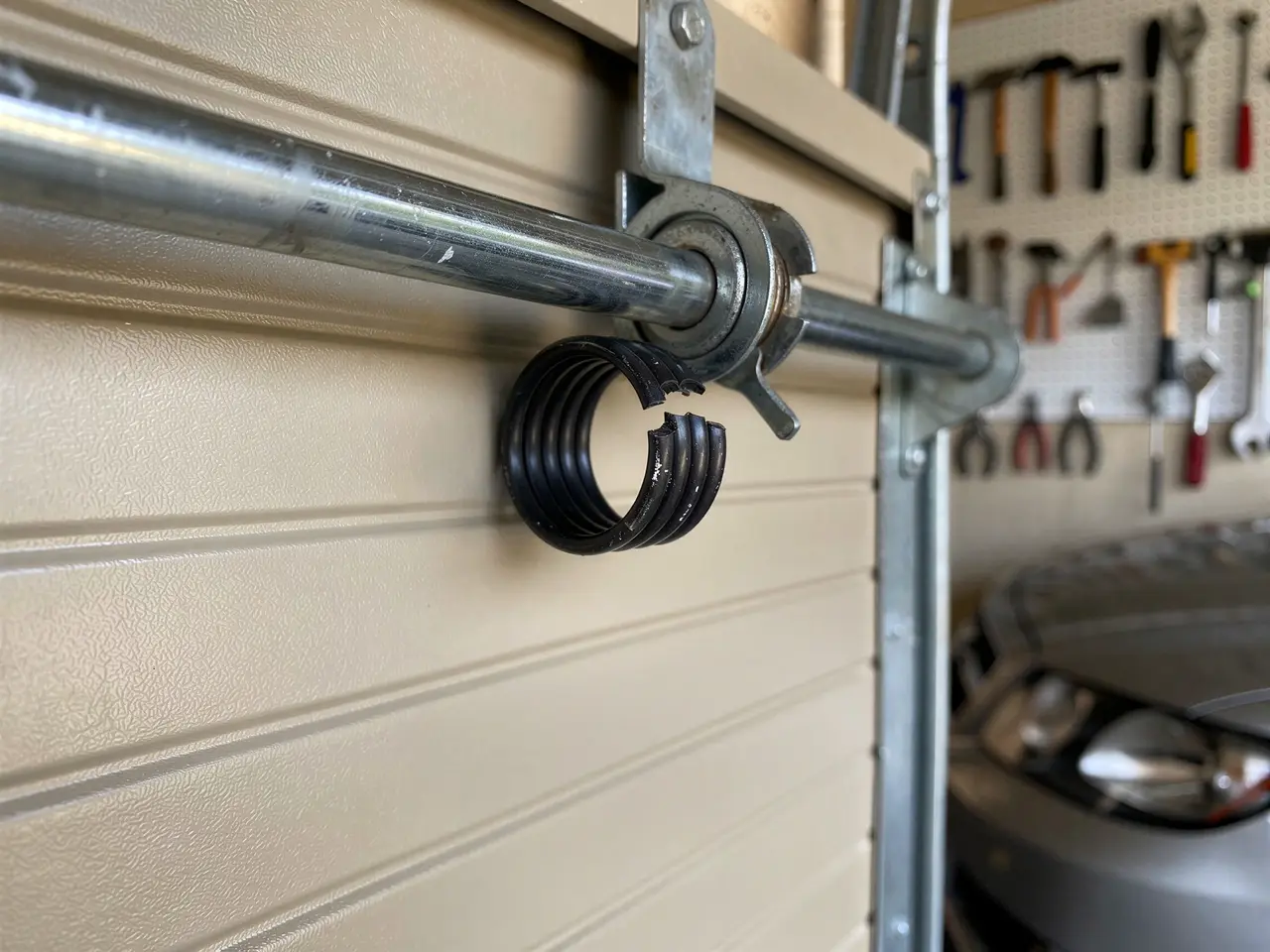
The most obvious sign is a door that won't move, or moves a few inches and stops. If you hear a loud bang from the garage before that happens, that's usually the spring itself letting go, not the opener. A torsion spring under tension snaps with real force, which is also why you don't want to be standing under the door or reaching for the bottom panel when it happens.
Short of a full break, you'll see smaller warning signs first. The door feels heavier to lift by hand than it used to. One side rises faster than the other, so the bottom panel goes up at an angle instead of flat. A cable that looks frayed or has visible slack when the door is down is often a spring problem showing up at the cable instead of the coil - the spring is losing tension unevenly and the cable is taking stress it wasn't built for.
Some owners notice the opener straining - grinding, slow movement, or the motor running longer than it used to for the same door. That's the opener trying to lift weight the spring used to carry. Running the opener against a dead or failing spring is one of the fastest ways to burn out the motor on top of the spring problem you already have.
What the Fix Involves
A proper spring repair starts with identifying what kind of spring system the door actually has - torsion springs mounted on a shaft above the door, or extension springs running along the horizontal tracks. A lot of the older stock in this service area still has the original torsion setup from installation, sometimes a single spring where current practice would use two for the same door weight.
The spring itself gets replaced, matched to the door's weight and the drum size on the shaft, not just swapped for whatever's closest. We check the cables at the same time, since a stressed or fraying cable is often what actually failed even when the spring triggered it. Rollers, hinges, and the bottom bracket get a look too, because a spring replacement on worn-out rollers just transfers the same strain somewhere else within a year.
This isn't a job to take on without the right bars and clamps. A torsion spring holds enough stored energy to break fingers or worse if it's wound or unwound with the wrong tools, and that's the honest limitation here: we don't walk homeowners through doing this one themselves over the phone, because the margin for a bad outcome is too high. It's one of the few garage door jobs where the DIY route costs more than it saves.
What It Costs
We don't post a flat number for spring repair because the price depends on things we can't see over the phone - whether the door uses one torsion spring or two, the door's weight and size, whether a cable or drum also needs replacing, and how old the rest of the hardware is. A single spring on a standard door is a different job from a dual-spring setup on a heavier insulated double door, and quoting one price for both would mean either overcharging someone or underbidding a job that turns into more work once we're on the ladder.
What we can tell you is what drives the number up or down: single vs. double spring, standard vs. heavy-duty coil, and whether cables, drums, or rollers need to come along with it. Given that the median household income across this service area runs around $58,255, we try to give a real number before we start, not a guess that balloons once the door's open - and we'll tell you plainly if a door's hardware is worn enough that spring-plus-cable work is a better use of your money than spring-only.
Frequently asked questions
Why did my garage door spring break with no warning?
Springs rarely snap without warning signs, but the signs are easy to miss - a slightly heavier door, a cable with a little slack, a faint popping sound. In this area, humid heat followed by a cold snap speeds up the rust-and-stress cycle on older torsion coils, so a spring that's been degrading for months can finally let go on what feels like an ordinary day.
Can I replace a garage door spring myself?
We'd rather you didn't. A wound torsion spring holds enough force to cause a serious injury if the winding bars slip or the wrong size spring goes on the wrong drum. This is one job where paying for the visit is cheaper than an ER trip, and we won't talk a homeowner through doing it solo over the phone.
Do both springs need replacing if only one breaks?
Often yes. On a double-spring torsion setup, the springs usually wear at close to the same rate, so if one's gone the other is typically close behind. We'll check the second spring's condition on site and tell you honestly whether it needs replacing now or can wait, rather than replacing it automatically.
How old does a garage door spring usually get before it fails?
It comes down to cycle count more than calendar age, but a lot of the torsion hardware still in use across this service area dates back to houses built in the 1960s and 70s. Original springs that have never been replaced on a door that old are well past a normal service life, even if they haven't broken yet.
Related services
Book garage door service in New Orleans
Call now or request a quote - tell us what the door is doing and where you are.