
New Orleans, LA · Garage Door Service
Garage Door Repair Built Around How New Orleans Houses Actually Age
Garage door repair for New Orleans homes built mostly between 1958 and 1997, where humidity, salt air, and original hardware wear springs and tracks faster than most places.
- Repairs & new doors
- Springs & openers
- Serving 7 nearby communities
Why This Fails Locally
Most of the garage doors we get called out on sit on houses built somewhere between 1958 and 1997, with the median landing around 1977. That's the housing stock across the 24 named areas we work - Algiers, Behrman, Old and New Aurora, Village De L'Est, and the rest. A door installed in that window is on its second or third opener by now, but the original track brackets and hinges are often still the ones from the day the slab cured.
Add New Orleans's climate band - mild with occasional freeze, but humid nearly every day of the year - and you get a specific failure pattern. Steel hardware from the 60s and 70s wasn't built with today's galvanizing, so it pits and rusts from the inside of the track channel out. Torsion springs lose temper faster in constant humidity than they do in a dry climate, even without a hard freeze to make them brittle. This isn't a generic wear-and-tear story. It's what happens to 1970s-era steel left outside year-round in a wet climate for four or five decades.
How It Shows Up
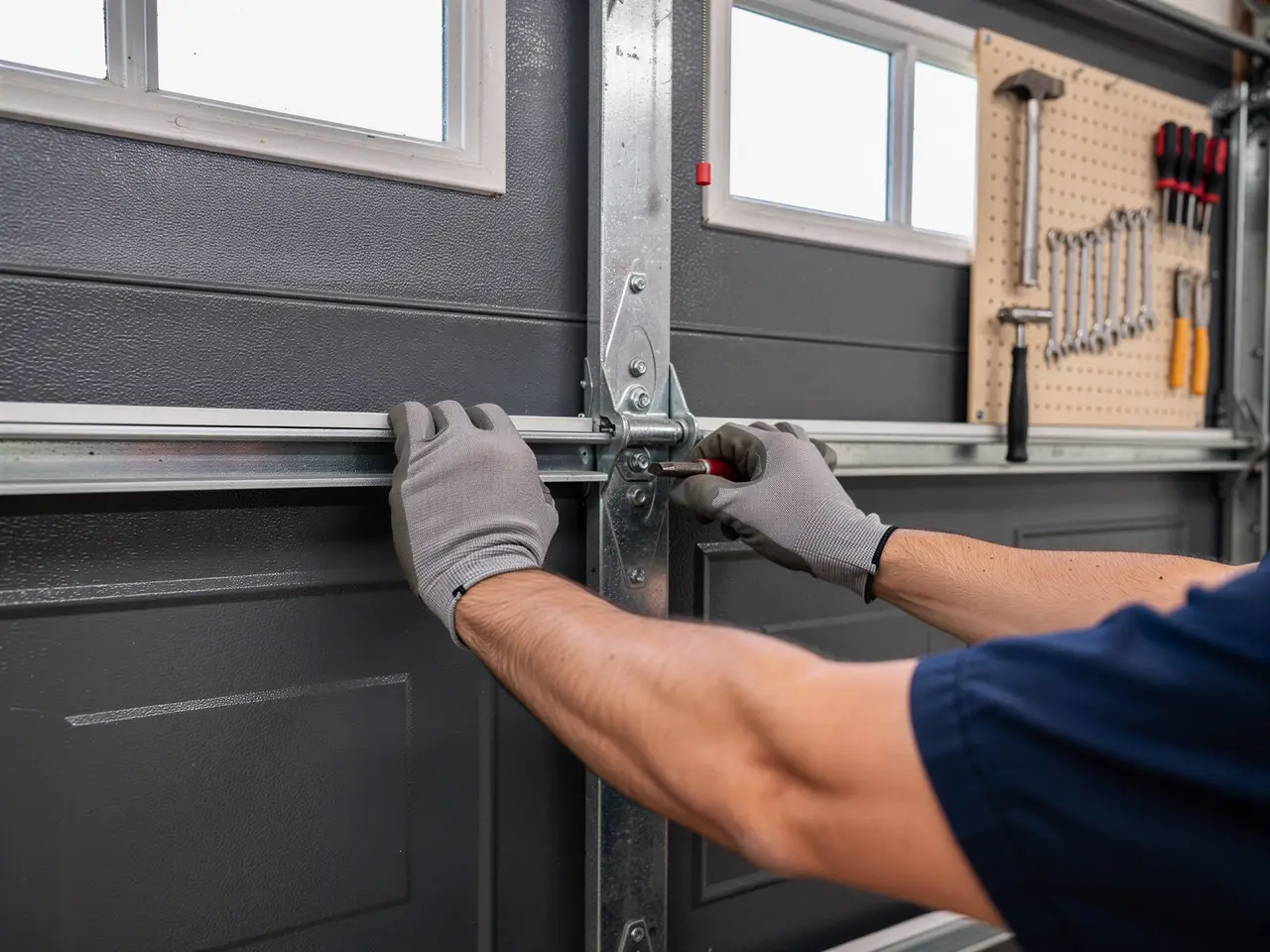
The door that used to open smooth now jerks about a foot off the slab and stalls. That's usually a spring that's lost enough tension to stop carrying its half of the door's weight, and on a house with original hardware it's rarely a clean, isolated failure - the cable drum and the roller brackets have usually been corroding alongside it the whole time.
On the older housing stock, we also see tracks that have pulled slightly out of plumb because the original lag bolts backed out of studs that have shifted over 40-plus years of settling, which is common on slab construction across this area. The door looks fine sitting still, then grinds or binds a few inches in. Openers from a 90s remodel are often fighting hardware twice their age, which shows up as a motor that strains, reverses, or trips the safety sensors on doors that haven't moved in years without complaint.
What the Fix Involves
On a house from this era, we don't just swap the broken part and leave the rest. If a torsion spring has gone on original hardware, we check the drums, the cable, and the track alignment at the same visit, because on 1960s-70s installs those parts usually fail in sequence, not isolation. Replacing one and leaving the other three to go next month costs the homeowner two service calls instead of one.
We stock torsion springs sized for the single and double doors common in these neighborhoods, since most of this housing stock still runs double-car doors on garages built flush with the original foundation. Track realignment is a common add-on rather than a stand-alone job here, because the slab shift that knocks hardware loose rarely stops at one bracket.
Honest limitation: if the door itself is original steel and the panels have rusted through at the bottom, we'll tell you that straight - a repair on a door that far gone is a short-term patch, and we'd rather say that up front than sell a fix that doesn't hold.
What It Costs
We don't post a flat number here because what drives the bill on a New Orleans house this age is almost never just the spring - it's how much of the original hardware around it has to come out at the same time. A single spring swap on hardware that's otherwise sound is a quick, contained job. A spring plus pitted drums plus a track that's walked out of alignment is a bigger ticket, and on houses built before 1977 that combination is common enough that we price it after we've actually looked at the track, not off a phone description.
With median household income across the service area at $58,255 and 66,523 owner-occupied houses among 133,464 households, we know most calls here are from people weighing a repair against a planned budget, not an emergency blank check. We'll tell you plainly when a repair is the cheaper right call and when the hardware's too far gone for that to make sense.
Frequently asked questions
Why do garage doors in New Orleans break more than in other cities with similar weather?
It's less about the weather event and more about the age of the hardware carrying it. Most of our service area's homes went up between 1958 and 1997, so a lot of torsion springs, drums, and track brackets are original steel that's spent 40-plus years in constant humidity, not a dry climate the hardware was rated for.
Do you work on houses in Algiers and the Lower Ninth Ward?
Yes, those are both part of our regular service area, along with Behrman, Village De L'Est, and the other named neighborhoods closer in. Distance from our base runs from a few miles up to around 20 for areas like Kenner and Waggaman.
Is it worth repairing an original 1970s garage door or should I replace it?
Depends on what's failed. A spring or cable on an otherwise sound door is worth fixing. If the bottom panel has rusted through or the track is badly warped from decades of shifted brackets, we'll say so - patching a door that far gone usually isn't the better value.
How fast does a broken spring usually need attention?
A broken torsion spring means the opener is lifting the full weight of the door alone, which strains the motor and gears fast. We don't quote a specific response window here, but a door stuck in that state shouldn't sit unused for long before the opener takes damage too.
Related services
Related guides
Book garage door service in New Orleans
Call now or request a quote - tell us what the door is doing and where you are.